
Contact:
Australian College of Nurse Practitioners
Nursing and Midwifery Board of Australia
Role
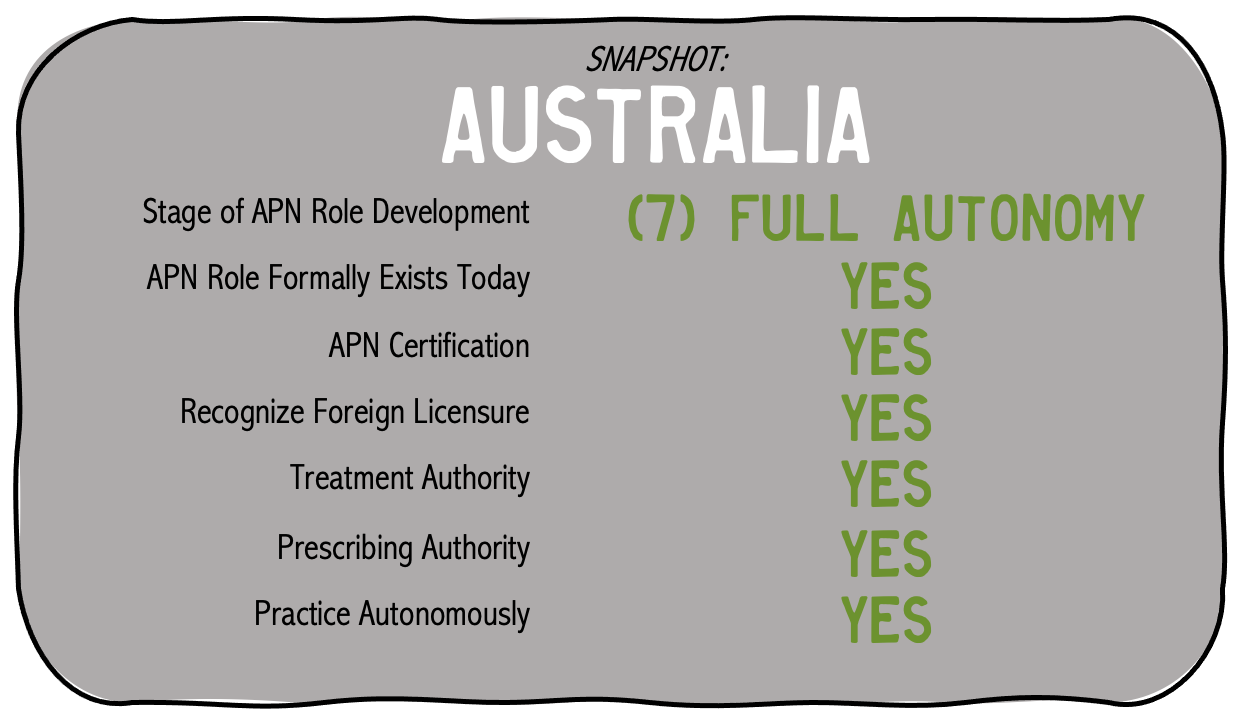
The Advanced Practice Nurse (APN) role in Australia was established in 1990 and the Nurse practitioner Role later established in 2000 (Sheer & Wong, 2008; Australian Government Department of Health and Aged Care [AGDHAC], 2023). However, while the title of APN is not legislatively protected, the Nurse Practitioner (NP) title is. With more than 20 years of role existence Australia has both championed the role of the Nurse Practitioner and continues to have immerging desire to expand the level of integration of the NP within the nation’s healthcare (AGDHAC, 2023; Jennings & Clothier, 2026).
Historically NPs are able to practice at a scope that allows them to both diagnose and prescribe treatments for patients across the spectrum in both acute, primary, and specialty care. Yet, barriers have remained largely in professional resistance, varying state regulations which also appear to have contributing to slow growth the NP workforce numbers and institutional regulations to allow NPs to practice to their full scope (AGDHAC, 2023; Fong, Buckley, Cashin, & Pont, 2017; Jennings & Clothier, 2026). While historically in 2010 the NP role required collaborative agreements with that of General Practitioners (Medical licensed individual) as of 2023 this requirement was removed allowing autonomous practice, due to collaborative agreements being a barrier to the access of care (Jennings & Clothier, 2026). Further in 2023 the AGDHAC (2023) further identified a workforce and established a Nurse Practitioner Workforce Plan to help promote access, awareness, and ability for the NP to work at their full scope of practice (AGDHAC, 2023).
Education and Certification
Education required for the Nurse Practitioner role requires a master’s degree in nursing which additionally certifies the passing individual for endorsement for registration. As a result, registration for the Nurse Practitioner does not require a single certification exam, but rather the educational institution will endorse the individual has passed certain competencies before they will endorse the candidate for registration. This same curriculum also a minimum of 5000 hours of clinical practice and supervision prior to being able to have prescribing rights (Jennings & Clothier, 2026).
See something and want to add to this page?
References:
Australian Government Department of Health and Aged Care [AGDHAC]. (2023, May). Nurse practitioner workforce plan. https://www.health.gov.au/sites/default/files/2023-05/nurse-practitioner-workforce-plan.pdf
Fong, J., Buckley, T., Cashin, A., & Pont, L. (2017). Nurse practitioner prescribing in Australia: a comprehensive literature review. Australian Critical Care. 30(5)252-259. doi:10.1016/j.aucc.2016.11.003
Jennings, N. & Clothier, V. (2026). Urgent care in Australia- Unblocking nurse practitioner capacity to systemic access issues. International Emergency Nursing. 85(2026). doi:10.1016/j.ienj.2026.101741
Sheer, B. & Wong, F.K. (2008). The development of advanced nursing practice globally. Journal of Nursing Scholarship, 40(3),204-211.
Originally Published 25 Aug 2013; Updated 28 Oct 2026

